
DART
Dallas Area Rapid Transit is a transit agency serving the Dallas–Fort Worth metroplex of Texas. It operates buses, light rail, commuter rail, and high-occupancy vehicle lanes in Dallas and twelve of its suburbs.
BUSINESS UNIT GOALS
Improving the Human Capital's core business processes, in particular recruitment cycle time, the employees and candidate experience.
PROBLEM STATEMENT AND METRICS
In July 2019, DART contracted with Iknow LLC for a follow-on assignment for their Human Capital Department (HR) that involved improving the HCs core business processes, in particular recruitment cycle time and candidate experience. Iknow recruited Mind Your Gaps to provide one component of this project which was to use the Service Design Methodology for improvement of Employee Experience as they processed new hire applications and the improvement of the Candidate Experience when they applied for a job with DART.
There was also a team member from Iknow who was going to take care of detailed study of their business process to undertake business process redesign. This would also serve as information needed by for Mind Your Gaps for the next phase of the project.
In this first phase of the project, Mind Your Gaps was a partner with Iknow in conducting a Visioning Workshop with the DART HC employees. Mind Your Gaps also gave them a 3 hour basic working training in the Service Design Methodology.
SIZE
14 employees and their Manager from the HC department, three members from the Senior Leadership team.
METHODOLOGY:
Our work involved four primary activities:
1. Identify leading recruiting practices
2. Introduce the Service Design Methodology
3. Evaluate and prioritize the leading recruiting practices
4. Establish DART’s recruiting future-state vision
1. IDENTIFICATION OF LEADING PRACTICES/LITERATURE REVIEW
The first activity was to identify, collect, and catalog the leading practices and benchmarks for the recruiting process.
The first step was to identify the leading practices by conducting a comprehensive literaturer eview. We reviewed hundreds of sources, including books, published articles, and online databases and content repositories. We leveraged our subscriptions to various paid sources, which included the Society of Human Resources (SHRM) content repositories, American Productivity and Quality Center’s (APQC) benchmarking databases, and International Organization for Standardization (ISO) standards.
We cataloged the leading practices by using the APQC’s Cross-Industry Process Classification Framework® (September 2018). The
Framework was used to organize the collection and analysis of best practices and benchmarks for the recruiting business process APQC’s primary recruiting process, named “Recruit, source, and select employees” (APQCP rocess ID 7.2), consists of five sub- processes. The five sub-processes and some of the best practices are listed below:
APQC 7.2.1: Manage Employee Requisitions
APQC 7.2.2: Recruit and Source Candidates
APQC 7.2.3: Screen and Select Candidates
APQC 7.2.4: Manage New Hires and Re-hires
APQC 7.2.5: Manage Applicant Information
Additional information was provided for each leading practice, such as when it was applicable, how much resources it would take to implement it, and how long it would take to implement it. The consolidated list was distributed to the internal recruiting team.
Our work involved four primary activities:
1. Identify leading recruiting practices
2. Introduce the Service Design Methodology
3. Evaluate and prioritize the leading recruiting practices
4. Establish DART’s recruiting future-state vision
1. IDENTIFICATION OF LEADING PRACTICES/LITERATURE REVIEW
The first activity was to identify, collect, and catalog the leading practices and benchmarks for the recruiting process.
The first step was to identify the leading practices by conducting a comprehensive literaturer eview. We reviewed hundreds of sources, including books, published articles, and online databases and content repositories. We leveraged our subscriptions to various paid sources, which included the Society of Human Resources (SHRM) content repositories, American Productivity and Quality Center’s (APQC) benchmarking databases, and International Organization for Standardization (ISO) standards.
We cataloged the leading practices by using the APQC’s Cross-Industry Process Classification Framework® (September 2018). The
Framework was used to organize the collection and analysis of best practices and benchmarks for the recruiting business process APQC’s primary recruiting process, named “Recruit, source, and select employees” (APQCP rocess ID 7.2), consists of five sub- processes. The five sub-processes and some of the best practices are listed below:
APQC 7.2.1: Manage Employee Requisitions
- Forecasting supply and demand gaps for critical positions and taking action to fill those gaps
- Having HR collaborate with business units to predict and define staffing requirements
- Having recruiters and hiring managers identify realistic expectations for job candidate qualification
- Automating job requisitions with technology, such as a robust candidate/applicant tracking system
APQC 7.2.2: Recruit and Source Candidates
- Establishing a strong employment brand to attract potential recruits
- Customizing the employment brand and candidate experience for different types of talent (e.g., technical talent, recent college graduates, etc.)
- Leveraging employee referral programs
- Using data about successful hires to select sources of future job candidates Forming relationships with proven sources of desirable job candidates, such as university career centers and professional associations
APQC 7.2.3: Screen and Select Candidates
- Utilizing automated candidate screening tools
- Implementing a competency-based selection program that includes pre-employment assessment tests
- Using behavior-based interview techniques and multi-function team interviews
- Selecting for fit with organizational culture and values
- Using data about successful hires (e.g., performance and attrition data) to select future hires
- Offering realistic job previews, using internships and job shadowing, for example
- Involving employees in screening and selecting candidates who could become their coworkers and fill job roles that are similar to their own
APQC 7.2.4: Manage New Hires and Re-hires
- Automating new hire processes to ensure consistency and reduce cycle time
- Keeping candidates informed throughout the hiring process
- Starting onboarding upon offer acceptance
- Making the onboarding process easy for new hires to follow
- Giving new hires some control over the onboarding process (e.g., the choice regarding different ways to obtain knowledge and build relationships)
- Measuring and working to improve on candidate and new hire satisfaction
APQC 7.2.5: Manage Applicant Information
- Having a paperless recruiting process where all candidate data is entered into an electronic candidate record
- Having external candidates use a self-service portal to enter personal data, work history, and education
- Notifying recruiters electronically of other positions for which a candidate might be qualified to apply
Additional information was provided for each leading practice, such as when it was applicable, how much resources it would take to implement it, and how long it would take to implement it. The consolidated list was distributed to the internal recruiting team.
2. SERVICE DESIGN METHODOLOGY TRAINING
The second activity was introducing the Service Design Methodology to the Human Capital’s Recruiting unit and leadership team. The objective was to familiarize the recruiting staff on the methodology that would be used to redesign the recruitment process. Based on Iknow’s previous work at DART, Iknow believed that the Service Design Methodology was the optimal approach for reengineering the recruiting business process.
Service Design Methodology (SDM) is a human-centered design approach that places equal value on the customer experience and the business process, aiming to create quality customer experiences and seamless service delivery. Service design helps organizations see an end-to-end, surface-to-core perspective, enabling the understanding of services from a customer perspective.
Service Design is rooted in design thinking, and brings a creative human-centered process to service improvement and designing new services. Through collaborative methods that engage both customers and service delivery teams, service design helps organizations gain a true, end-to-end understanding of their services, enabling holistic and meaningful improvements.
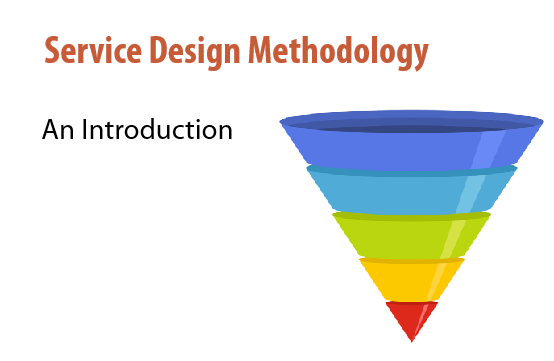
Mind Your Gaps prepared a training presentation on SDM which involved the engagement of the participants. The presentation introduced the core concepts of Service Design thinking and also created a half-dozen training exercises to accompany the presentation and a twelve-page written handout that summarized the highlights and key takeaways from the presentation.
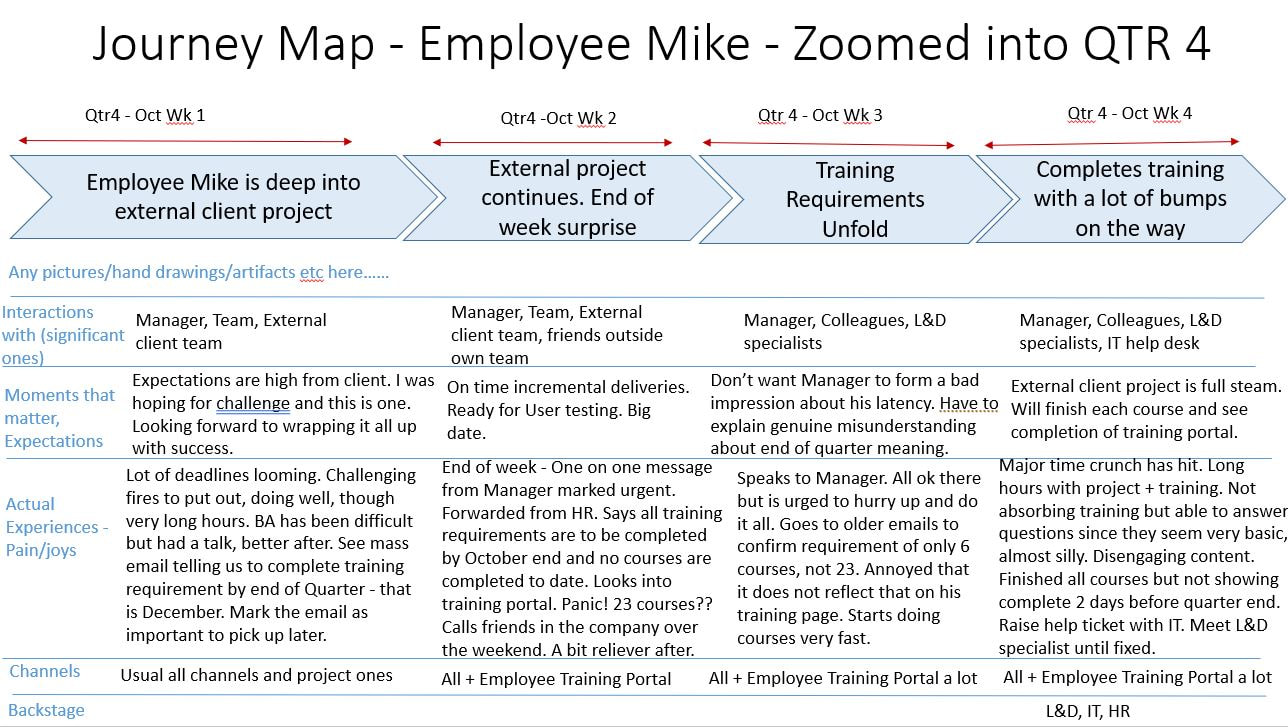
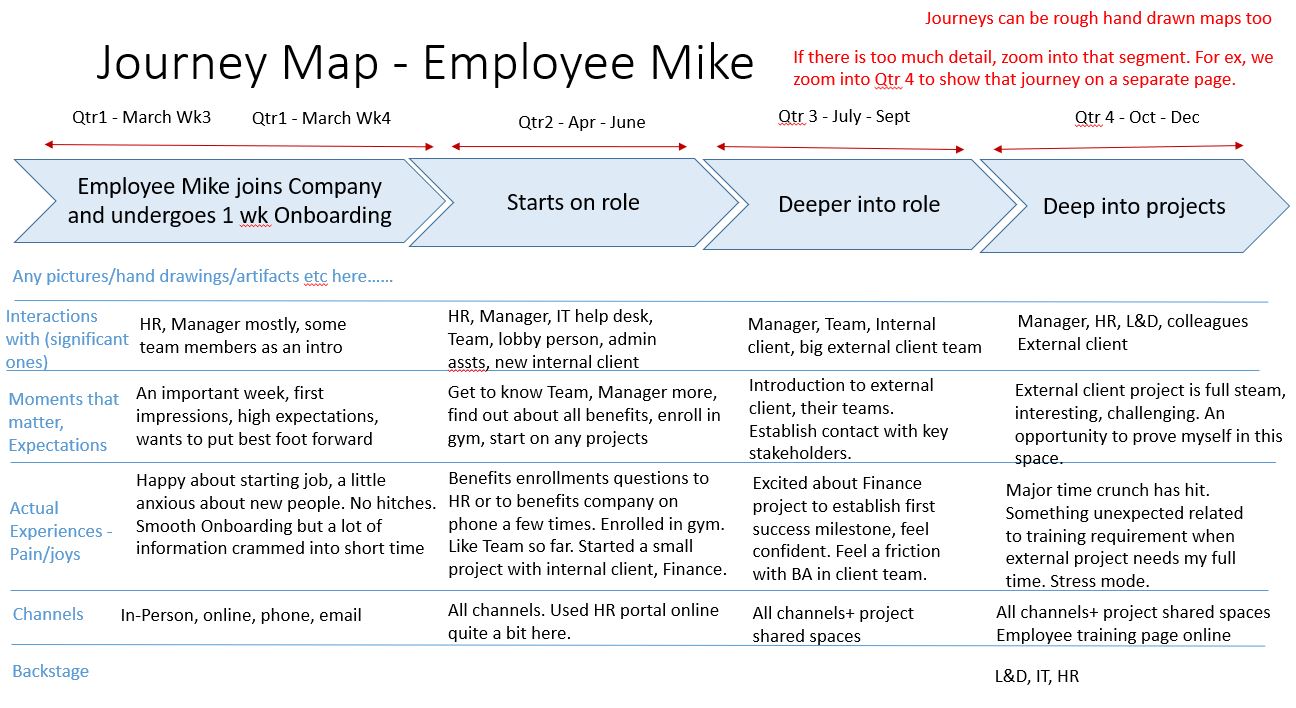
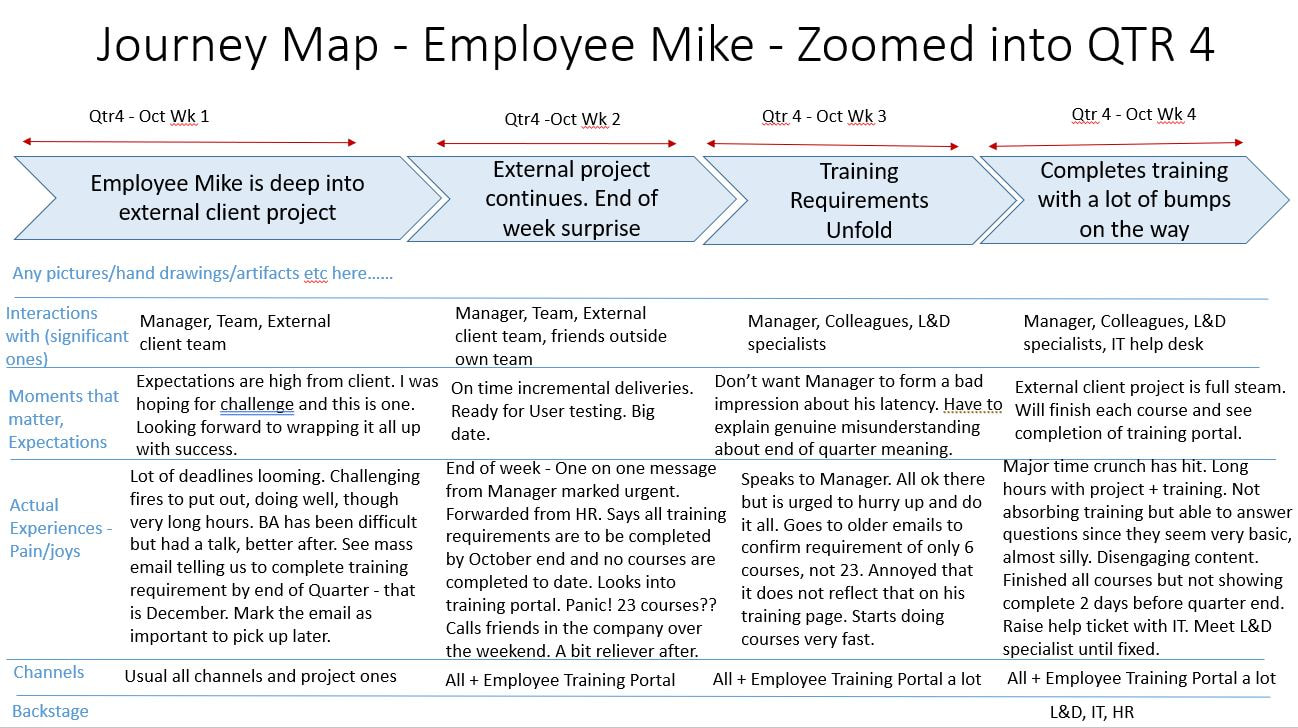
An example used was the journey of Employee Mike, his experience with Moments that Matter, Pain points, Joys and Channels used,
Workshop Presentation. Click to open.
|
|
3. VISIONING WORKSHOP
The third activity was the evaluation and prioritization of the leading practices to establish DART’s recruiting future-state vision. The evaluation was based on the applicability of the best practice in DART’s HC environment and on the synergy of the best practice with the Service Design Methodology.
Our research had identified 52 potential leading practices that could apply to DART’s recruiting process. The leading practices were divided up and assigned to the members of DART’s recruiting team two weeks before the workshop date.. DART’s staff prepared a one-page summary description for each leading practice. The one-page descriptions followed a standardized template that contained fields to describe the best practice and rate it on multiple dimensions.
(A). They read pre-work articles. Two people were assigned the same articles and worked as a team. They identified 2 or 3 points from the article as best practices.
Their instructions were --
- Read each article in your zip file.
- Create a one-page PowerPoint summary for every best practice you find in your articles. Please try to identify 2 or 3 best practices per article. Some articles may have more, and some may have less. Please use the PowerPoint template for your summaries. Only one BP per slide.
(B) They filled a Power point template with one best practice per slide and brought it along to the workshop, Each team of two presented and discussed aloud the rationale behind why they would like this Best Practice, its impact and its feasibility (level of effort) within their organization.
Our goal was to have 2 to 3 best practices per article from the 35 articles distributed between the 7 teams.
(C) One facilitator from our team took raw notes on flip chart of the most important points that are being made. Asked questions for clarifications, made comments but mostly let them talk.
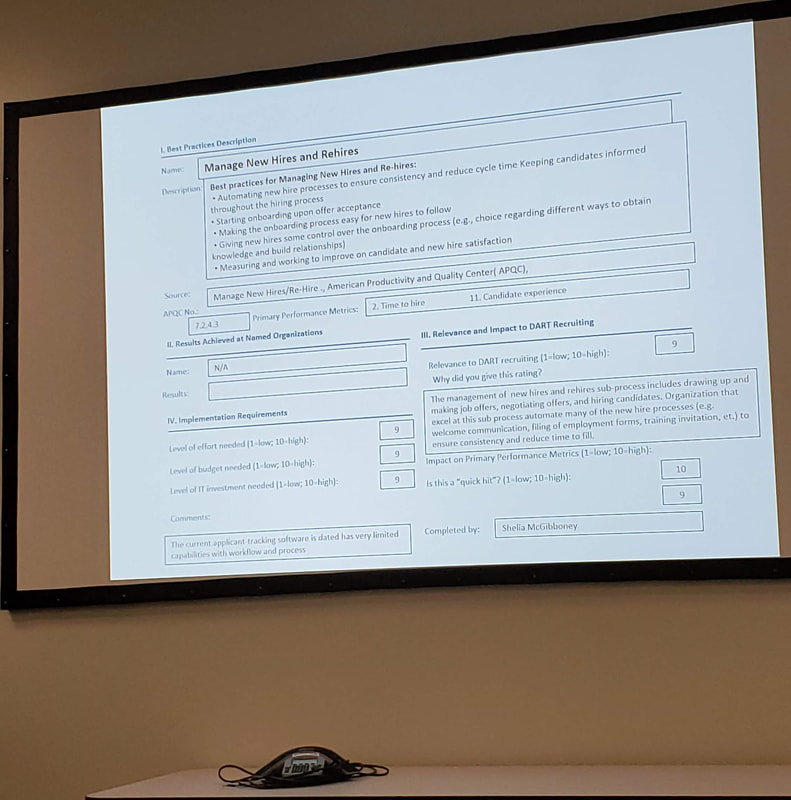
Presentation by one of the DART two person team
|
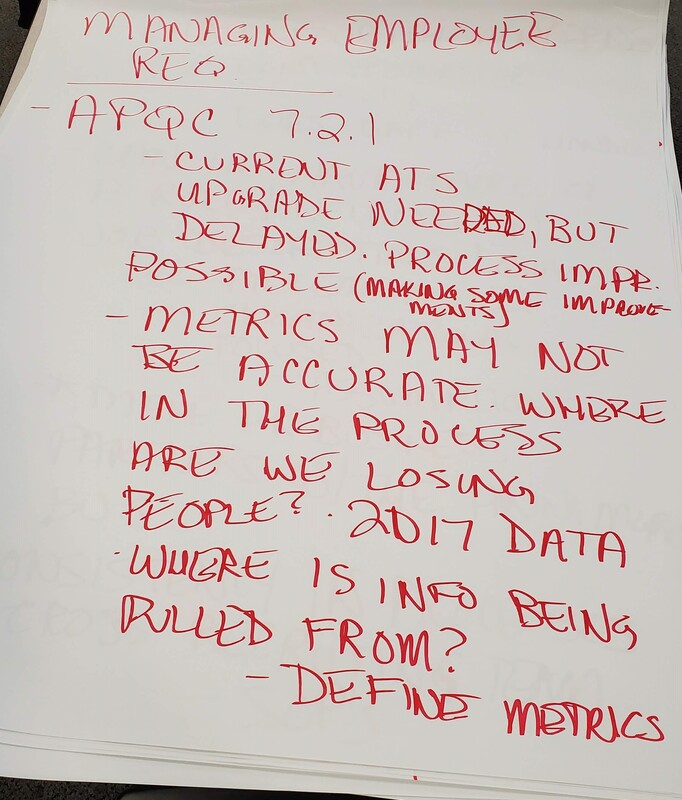
Capturing notes by our team on flip chart as presentation and discussions occurred between the DART team

| ||
(D) Next, we consolidated the participants’ completed PPTs into a master PPT deck.
(E) We drew five three grid squares on white board. Since we had five topics.
(F) We then taped each best practice template sheet with its number like 1a, 1b etc. on the board. A bit confusing because 1 a or 1b etc has more than one BP instead of just one!! See pictures below.
(G). Next we asked the participants of each team to write out each of their best practice numbers on a separate sticky note (1A, 1B etc). For example, the topic 7.2.1 Manage Employee Requisitions has 9 best practices they had identified and so sticky notes went from 1A to 1J.
(H). Get that team to place that best practice sticky note in the 3x3 grid where they deem appropriate, in terms of Impact (Value to Customer) and Urgency. Before the sticky is placed though, all teams pipe in to give their insights on where it is to be placed, they arrive at a consensus and then they place it.
Basically, at this point they are mostly agreeing or re-iterating what they discussed before (as seen in raw notes) but still they have differences in urgency, feasibility at times.
(I) We the facilitators continued with note taking throughout these discussions on where the sticky needed to be placed and why. This was captured in the Report Out file.
| dart_report_out_112019.pdf |
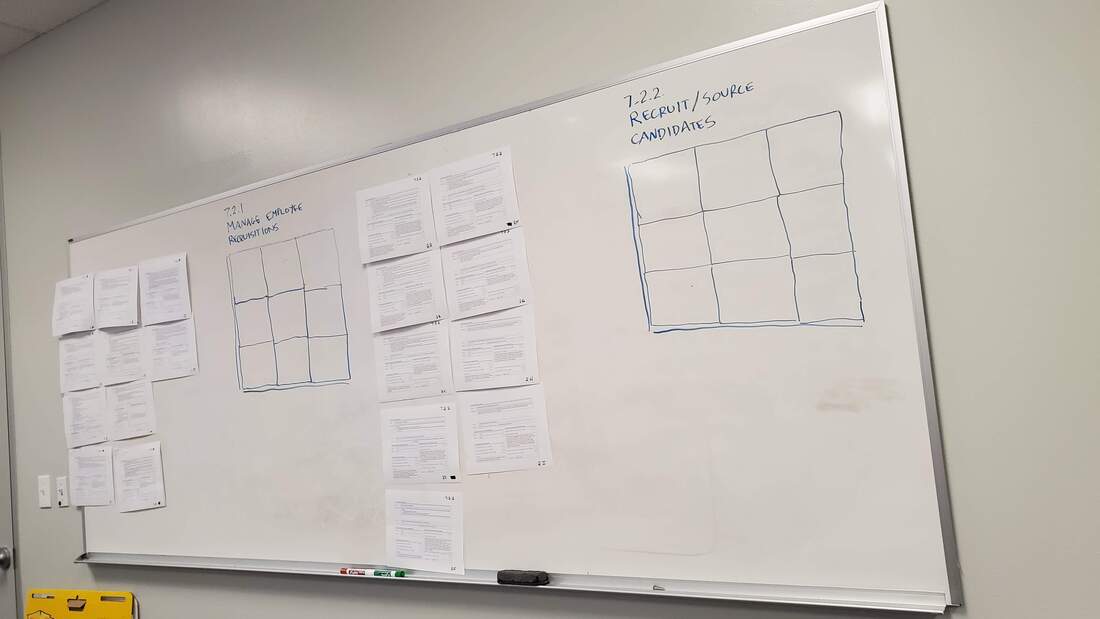
|
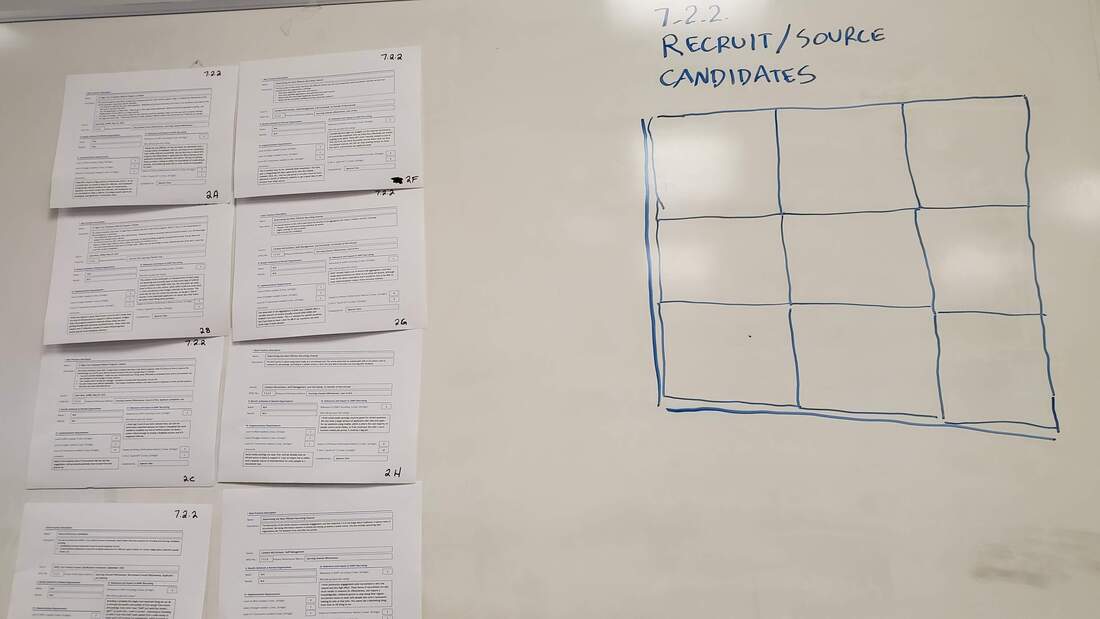
|
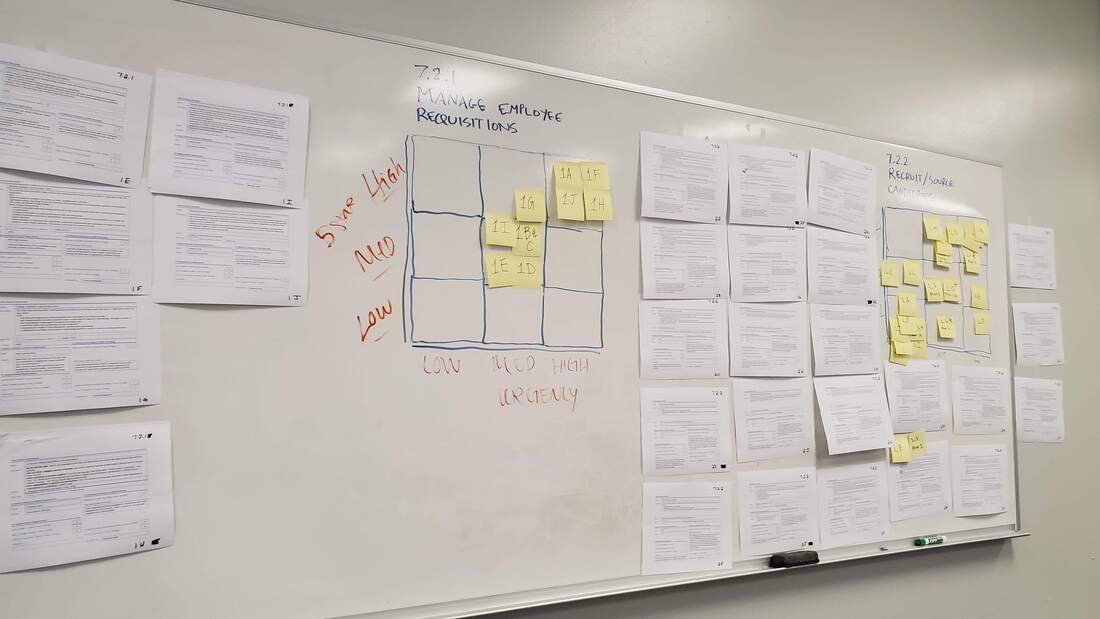
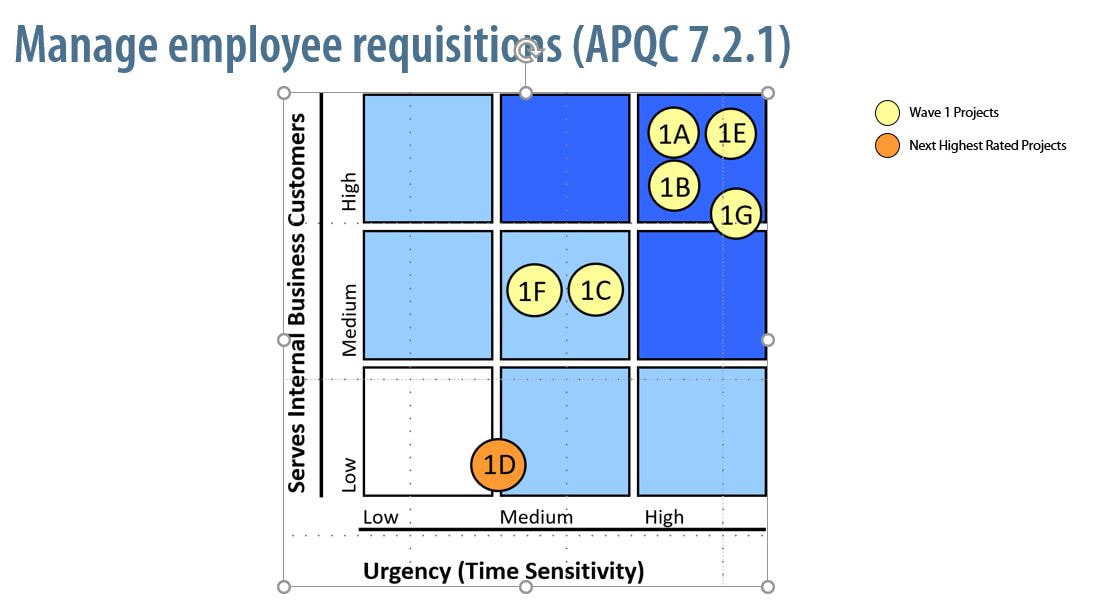
Two dimensions were selected - Prioritization/Importance on how it will serve Internal (DART) Business Customers, and Urgency (Time Sensitivity). Each group of leading practices, based on the APQC subprocess category, was prioritized on a 3x3 grid, The leading practices positioned in the upper right-hand corner are rated higher on both dimensions than those practices positioned in the lower left-hand corner.
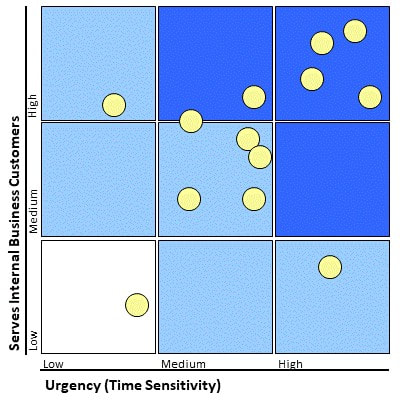
Evaluation Grid
|
4. RESULT - Evaluation and Prioritization of the Leading Practices At the end of the workshop we had a stickies in each of the 5 topics and we transferred the most impactful and most urgent ones into this grid which serves as a roadmap for the highest priority projects going into the future. The second wave of projects can similarly be determined. The report out gives the DART several practices to follow up on that have been a direct result of the workshop and tie to the APQC framework as well. Refer to the file below. 
| ||
5. RESULTS/IMPACT
The visioning workshop served as a great starting point for DART to determine which projects needed to the undertaken as a first wave towards improving their core business processes, in particular recruitment cycle time and experience of candidates and employees.
5. RESULTS/IMPACT
The visioning workshop served as a great starting point for DART to determine which projects needed to the undertaken as a first wave towards improving their core business processes, in particular recruitment cycle time and experience of candidates and employees.